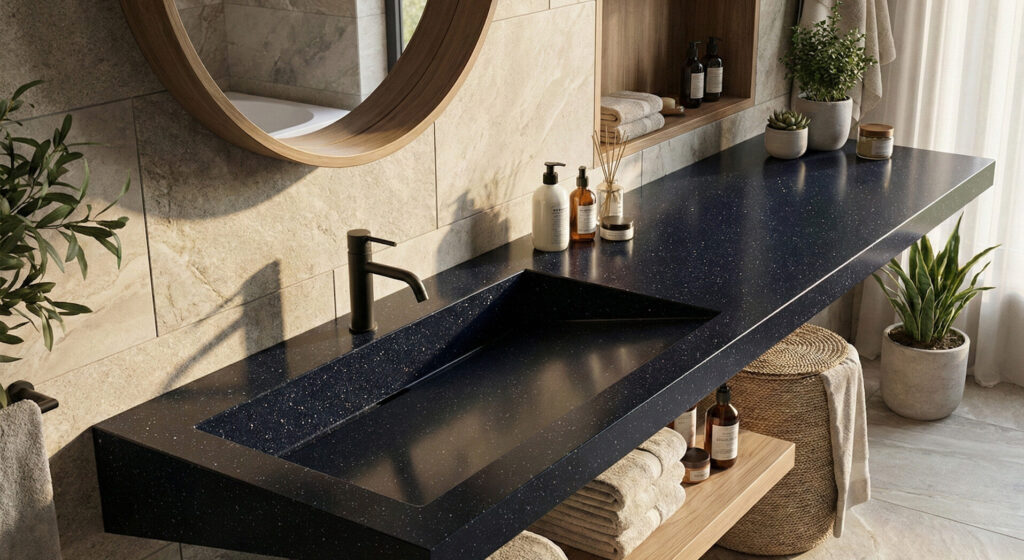
Solid Surface vs Quartz vs Marble: Which is Best for Your Bathroom Vanity Top?
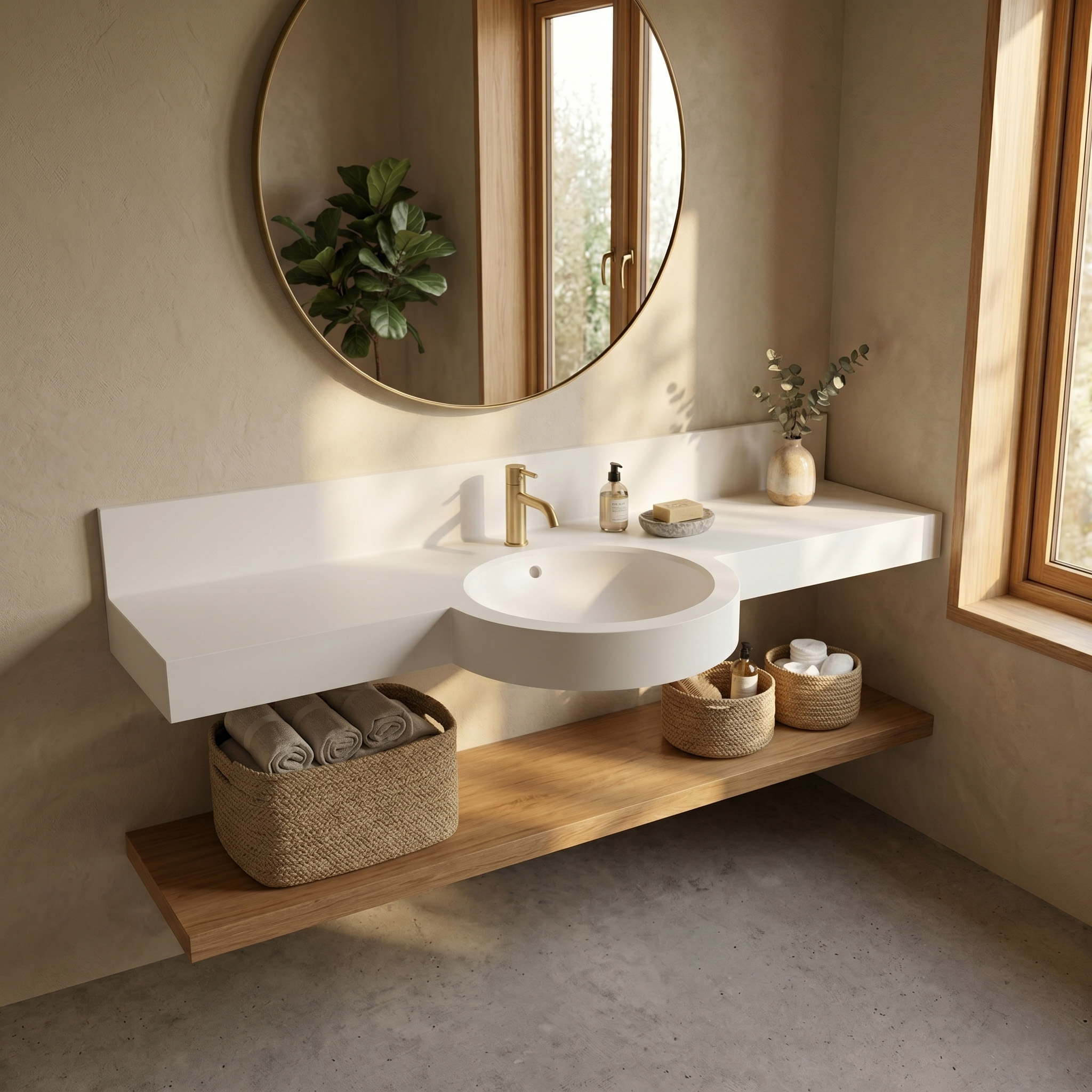
Choosing the right material for your bathroom vanity top is one of the most important decisions in any bathroom renovation. Solid surface, quartz, and marble each offer distinct advantages — but only one of them can be fully customised to the millimetre, repaired if scratched, and ordered directly online without a designer.
This guide compares all three materials across the factors that matter most: durability, hygiene, maintenance, customisation, and price.
What is Solid Surface?
Solid surface is a manufactured material made from acrylic resins blended with natural minerals. It was first introduced by DuPont™ under the brand name Corian® and has since expanded into a range of premium brands including Staron® and Meganite®.
Unlike natural stone, solid surface is completely homogeneous — the colour and composition run through the full depth of the material. This makes it uniquely repairable: minor scratches and surface damage can be sanded and buffed back to a brand-new finish.
korte.design manufactures custom solid surface vanity tops using Corian®, Staron® and Meganite® — engineered to exact millimetre dimensions with integrated washbasins, available in 25 colour and finish options.
What is Quartz?
Engineered quartz is made from approximately 90–95% natural quartz particles bound with polymer resins and pigments. It is one of the hardest bathroom countertop materials available and is highly resistant to scratching and staining.
Unlike solid surface, quartz cannot be thermoformed into curves or fully integrated basin shapes. It also cannot be repaired if chipped or cracked — damaged sections must be replaced entirely.
What is Marble?
Marble is a natural stone prized for its distinctive veining and luxurious appearance. Each slab is unique, which gives marble vanity tops an organic, high-end feel.
However, marble is a porous material that requires regular sealing to prevent staining. It is also susceptible to etching from acidic substances — common in bathrooms — such as toothpaste, certain soaps, and cleaning products.
Solid Surface vs Quartz vs Marble: Side-by-Side Comparison
| Feature | Solid surfaceCorian® · Staron® · Meganite® | QuartzEngineered stone | MarbleNatural stone |
|---|---|---|---|
| Durability | |||
| Scratch resistance | |||
| Heat resistance | |||
| Hygiene (non-porous) | ✓ Yes | ✓ Yes | — Requires sealing |
| Repairable | ✓ Yes | — No | — No |
| Integrated basin | ✓ Seamless | — No | — Rare |
| Fully custom dimensions | ✓ mm precision | Limited | Limited |
| Thermoformable | ✓ Yes | — No | — No |
| Maintenance | Low | Low | High |
| Price range | Medium | Medium–High | High–Very high |
Hygiene: Why Solid Surface Wins in the Bathroom
Hygiene is a critical factor for bathroom vanity tops. Solid surface is non-porous, which means bacteria, mould, and moisture cannot penetrate the surface. Because there are no grout lines or visible joints, a solid surface vanity top with an integrated basin offers the most hygienic option available for bathroom applications.
Quartz is also non-porous and shares similar hygiene properties. Marble, however, is a natural stone with a porous surface that absorbs liquids if not properly sealed — making it the least hygienic option of the three for high-use bathrooms.
Customisation: The Solid Surface Advantage
Solid surface is the only material of the three that can be:
- Thermoformed — heated and shaped into curves, rounded edges, and complex forms
- Integrated seamlessly — basins and vanity tops produced as a single, jointless piece
- Machined to exact dimensions — millimetre-precise CNC manufacturing for made-to-measure bathroom countertops
- Fully customised online — korte.design’s 3D configurator allows architects, designers and private clients to design a custom solid surface vanity top in real time, with instant pricing
Quartz and marble are typically available in standard slab sizes and pre-cut formats, limiting the degree of customisation possible without significant cost and lead time.
Repairability: Only Solid Surface Can Be Renewed
One of the most compelling advantages of solid surface vanity tops is their repairability. Because the material is homogeneous throughout, minor scratches, surface marks, and everyday wear can be sanded and buffed back to the original finish — restoring the vanity top to a brand-new condition, even after years of daily use.
Quartz cannot be repaired in the same way — chips and cracks require professional replacement of the affected section. Marble is similarly difficult to repair and is prone to permanent etching from acidic substances.
For long-term value, a solid surface vanity top is the most sustainable choice — designed to last decades, not years.
Maintenance: What to Expect Day to Day
Solid surface: Clean with mild soap and water. No sealing required. Surface can be refreshed with light sanding if needed.
Quartz: Clean with mild soap and water. No sealing required. Avoid prolonged exposure to direct heat.
Marble: Requires regular sealing (typically every 12–18 months). Use only pH-neutral cleaners. Susceptible to etching from acidic products.
For low-maintenance bathrooms used by families or in commercial projects, solid surface and quartz are both strong choices. Marble demands considerably more care.
Price: Solid Surface Offers the Best Value for Custom Projects
Natural marble is typically the most expensive option, particularly for custom sizes and integrated basins. Quartz occupies a similar price bracket for custom work.
Solid surface offers a competitive price point for fully customised, made-to-measure vanity tops — particularly when ordered directly from the manufacturer. korte.design’s online 3D configurator generates real-time pricing as you design, eliminating manual estimates and designer fees.
Which Material is Right for You?
Choose solid surface if:
- You need a fully custom made-to-measure vanity top with an integrated basin
- Hygiene and easy maintenance are priorities
- You want a repairable, long-lasting surface
- You are an architect, designer or contractor specifying for residential or commercial projects
Choose quartz if:
- You need maximum scratch and impact resistance
- You prefer the look of engineered stone
- Standard sizing fits your project
Choose marble if:
- Aesthetic luxury is the primary driver
- The bathroom is low-traffic (e.g., a powder room)
- You are willing to commit to regular maintenance and sealing
FAQ: Solid Surface vs Quartz vs Marble
Is solid surface better than quartz for bathrooms? Solid surface and quartz are both non-porous and low-maintenance. Solid surface has the added advantage of being fully repairable, thermoformable into integrated basin designs, and available in custom made-to-measure dimensions — making it the preferred choice for architects and designers who need precision and flexibility.
Can solid surface vanity tops be repaired? Yes. Solid surface is one of the only bathroom countertop materials that can be repaired. Minor scratches and surface damage can be sanded and buffed back to the original finish, restoring the vanity top to a brand-new condition.
Is solid surface hygienic for bathrooms? Yes. Solid surface is a non-porous material, which means bacteria, mould and moisture cannot penetrate the surface. Combined with seamless integrated basin construction — no joints, no grout lines — it is one of the most hygienic bathroom countertop materials available.
How long does a solid surface vanity top last? A solid surface vanity top manufactured to professional standards is designed to last decades. Its repairability means the surface can be renewed rather than replaced, making it a long-term investment for both residential and commercial bathrooms.
What brands of solid surface does korte.design use? korte.design manufactures custom solid surface vanity tops using Corian® by DuPont™, Staron® and Meganite® — three of the leading premium solid surface material brands. korte.design is a certified DuPont™ Corian® Quality Network Industrial Partner.
korte.design is a European manufacturer of custom solid surface vanity tops, serving architects, interior designers, contractors and private clients. Design your made-to-measure vanity top using our online 3D configurator — with real-time pricing and augmented reality preview.
Explore our solid surface materials or contact us to discuss your project.